Shaykh Ibn Uthaymeen رَحِمَهُ ٱللَّٰهُ
Conditions of the prayer are that which the correctness of the prayer is dependent upon, because a “condition” linguistically is a sign. Allah, the Most High said:
فَهَلْ يَنظُرُونَ إِلَّا ٱلسَّاعَةَ أَن تَأْتِيَهُم بَغْتَةًۭ ۖ فَقَدْ جَآءَ أَشْرَاطُهَا ۚ فَأَنَّىٰ لَهُمْ إِذَا جَآءَتْهُمْ ذِكْرَىٰهُم
“Do they then await (anything) other than the Hour, that it should come upon them suddenly? But some of its portents (indications and signs) have already come…”
[Muhammad: 18] Referring to its signs.
📚 And a “condition” in the terminology of specialists in principles of fiqh (jurisprudence) is: “That which necessitates absence (of an affair) in its absence, and does not necessitate presence (of an affair) in its presence,” (meaning if the condition is absent, the affair that requires this condition can therefore not exist independently, however conversely, if the condition is present, it does not necessitate that the affair that required it will definitely be present too).
–
🕰 The First Condition: Entry of the Time
–
The evidence that the entry of time is a condition for the prayer is the statement of Allah, the Most High:
إِنَّ ٱلصَّلَوٰةَ كَانَتْ عَلَى ٱلْمُؤْمِنِينَ كِتَـٰبًۭا مَّوْقُوتًۭا
“Verily, the prayer is enjoined on the believers at fixed hours.”
[Al-Nisa: 103], meaning it is obligated at fixed times.
So, the prayer is invalid before the time, even if the person was ignorant or forgetful, and it is invalid after the time unless he is excused (with a legitimate reason).
📌 From the blessings of Allah is that these prayers are distributed over different times that Allah the Mighty and Majestic chose as their times, and they are not all in one time together. So, Fajr has its time, Dhur has its time, Asr has its time, Maghrib has its time, Ishaa has its time: so why were they distributed over these times?
The answer- for two benefits:
📍1- The First Benefit: Weariness and tedium does not occur to the person, since if they were all combined into one time a person may be overcome with difficulty sometimes. If a person prayed 17 units (Rak’ah) all at one time, he may become tired and weary and pray them in a manner not accurate. Sometimes it may be burdensome, hence they have been split into five times.
🖊️ So, if it said, “What do you say about Tarawih prayer in Ramadan?” We say, Tarawih prayer is a Sunnah, if a person wishes he could leave it. For example, if he became tired, he is free to leave it and rest. If, however, it is an obligatory prayer then he is compelled to complete it upon the prescribed manner it has been mentioned (in the Sunnah), so this is a difference between the two.
📍2- The Second Benefit: If the prayers were all combined into one time a person would be left the rest of the day and night without worshipping his Lord with obligatory prayer. This results in suspension between a servant and his Lord in the obligatory prayer. Hence the benefit is not achieved, since it brings life to the heart and closeness to Allah.
This is why Allah said:
وَأَقِمِ ٱلصَّلَوٰةَ لِذِكْرِىٓ
“And perform As-Salât (Iqâmat-as-Salât) for My Remembrance.”
[Taha: 14]
📍- Hence the prayer is remembrance of Allah.
📌 It is not permissible to pray a prayer before its time even if he was forgetful or ignorant (of the actual time), and it is upon him to repeat the prayer, just like someone who slaughters before the Eid prayer: that slaughtering does not count for him, even if he was ignorant (i.e. did not realize the time had not started yet). This is why the Prophet (ﷺ) commanded those who had slaughtered on ‘Eid Adha before the Eid prayer to repeat the slaughtering, since it had occurred before its time.
🖊 [Example] If a man purposely delayed the prayer beyond its time without a reason and then he prayed it out of its time- such as someone who prays Fajr after sunrise on purposely because he says he will not get up until it is time for work, and then he wakes up and gets ready, then prays (and goes to work)
📍- indeed the prayer as such will not be accepted from him even if he prays it one thousand times.
The evidence for that is the statement of Allah:
إِنَّ ٱلصَّلَوٰةَ كَانَتْ عَلَى ٱلْمُؤْمِنِينَ كِتَـٰبًۭا مَّوْقُوتًۭا
“Verily, the prayer is enjoined on the believers at fixed hours.” (Al-Nisa: 103)
In other words, it is allocated by time, so if someone delays it beyond the time purposely, then he is a wrongdoer and transgressor due to the statement of Allah:
وَمَن يَتَعَدَّ حُدُودَ ٱللَّهِ فَقَدْ ظَلَمَ نَفْسَهُۥ ۚ
“And whosoever transgresses the set limits of Allâh, then indeed he has wronged himself.”
[Talaq: 1]
وَمَن يَتَعَدَّ حُدُودَ ٱللَّهِ فَأُو۟لَـٰٓئِكَ هُمُ ٱلظَّـٰلِمُونَ
“And whoever transgresses the limits ordained by Allâh, then such are the wrong-doers.”
[Baqarah: 229]
📌 And it is not accepted from the wrongdoer and transgressor, because Allah is ‘Tayyib’ and only accepts the good. If he delays the prayer out of its time on purposely without reason and prays it after the time, then he has performed it in a manner that does not conform to the manner of Allah and His Messenger (ﷺ) . And it has been authenticated from the Prophet (ﷺ) that he said:
مَنْ أَحْدَثَ فِي أَمْرِنَا هَذَا مَا لَيْسَ فِيهِ فَهُوَ رَدٌّ
“Whosoever introduces anything into this matter of ours (i.e. into Islam) that is not from it shall have it rejected” i.e. from him.
[Al-Bukhari 2697] & [Muslim 1718]
🖊 So, if someone were to say, if a person delayed the prayer beyond its time purposely, then what is he to do now?
We say, he repents to Allah, and rectifies his actions, and making it up is not upon him. The evidence is what we have mentioned just now from the verse and hadeeth, and we only say that he does not have to make it up since by making it up it would not benefit him in this circumstance, so it is an action he does not benefit from.
📍As for a person delaying it out of forgetfulness, or sleep, or not realizing the time- for example, due to cloud cover, and as a result he does not know the time because he has no watch- then these types pray whenever such reasoning is removed due to the statement of the Prophet (ﷺ):
مَنْ نَسِيَ صَلاَةً فَلْيُصَلِّ إِذَا ذَكَرَهَا، لاَ كَفَّارَةَ لَهَا إِلاَّ ذَلِكَ ”. {وَأَقِمِ الصَّلاَةَ لِذِكْرِي}
“If any of you sleeps through the prayer, or forgets it, then he is to pray when he remembers. Indeed, Allah says, “Establish prayer for My (I.e. Allah’s) remembrance.”
[Taha: 14] & [Bukhari 597 and Muslim 684]
–
💧🚿 The Second Condition: Purification from Minor and Major Impurity
–
📍- The minor impurity is what necessitates Wudu (ablution), and major impurity is what necessitates ghusl, due to the statement of the Prophet (ﷺ):
لاَ تُقْبَلُ صَلاَةٌ بِغَيْرِ طُهُورٍ
“A prayer is not accepted without purification.”
[Muslim: 224]
📌 And there is no difference between supererogatory and obligatory prayer, neither between a prayer that has bowing and prostration and a prayer that does not have bowing and prostration, like Janazah prayer (prayer upon the deceased).
–
❌💧 The Third Condition: Avoidance of Impurity
–
📍- There must not be any impurity on your garment, nor on your body, nor on the ground which you will pray upon. Hence, avoiding impurity is required in three affairs:
- The body
- The clothing
- The area of ground
🔗 The evidence is that a small boy was brought to the Prophet (ﷺ), meaning a baby not yet eating solids, he was still drinking milk only. He urinated on his garment so he called for water and followed up on the traces (cleaned the areas with water where urine fell).
[Bukhari 223] & [Muslim 287]
📍- This can be utilized as the evidence that the garment must be pure.
Another evidence, Abu Sa’id al-Khudri (رضي الله عنه) narrated:
قَالَ بَيْنَمَا رَسُولُ اللَّهِ صلى الله عليه وسلم يُصَلِّي بِأَصْحَابِهِ إِذْ خَلَعَ نَعْلَيْهِ فَوَضَعَهُمَا عَنْ يَسَارِهِ فَلَمَّا رَأَى ذَلِكَ الْقَوْمُ أَلْقَوْا نِعَالَهُمْ فَلَمَّا قَضَى رَسُولُ اللَّهِ صلى الله عليه وسلم صَلاَتَهُ قَالَ ” مَا حَمَلَكُمْ عَلَى إِلْقَائِكُمْ نِعَالَكُمْ ” . قَالُوا رَأَيْنَاكَ أَلْقَيْتَ نَعْلَيْكَ فَأَلْقَيْنَا نِعَالَنَا . فَقَالَ رَسُولُ اللَّهِ صلى الله عليه وسلم ” إِنَّ جِبْرِيلَ صلى الله عليه وسلم أَتَانِي فَأَخْبَرَنِي أَنَّ فِيهِمَا قَذَرًا ” . وَقَالَ ” إِذَا جَاءَ أَحَدُكُمْ إِلَى الْمَسْجِدِ فَلْيَنْظُرْ فَإِنْ رَأَى فِي نَعْلَيْهِ قَذَرًا أَوْ أَذًى فَلْيَمْسَحْهُ وَلْيُصَلِّ فِيهِمَا
While the Messenger of Allah (ﷺ) was leading his Companions in prayer, he took off his sandals and laid them on his left side; so when the people saw this, they removed their sandals. When the Messenger of Allah (ﷺ) finished his prayer, he asked: What made you remove your sandals? The replied: We saw you remove your sandals, so we removed our sandals.
The Messenger of Allah (ﷺ) then said: Gabriel came to me and informed me that there was filth in them. When any of you comes to the mosque, he should see; if he finds filth on his sandals, he should wipe it off and pray in them.
[Abu Dawud 650] & [Ahmad 3/92]
📍- This indicates it is impermissible for a person to continue wearing an impure garment during the prayer.
And the evidence upon the requirement of pure location to pray on is the statement of Allah, the Most High:
وَطَهِّرْ بَيْتِىَ لِلطَّآئِفِينَ وَٱلْقَآئِمِينَ وَٱلرُّكَّعِ ٱلسُّجُودِ
“And sanctify My House for those who circumambulate it, and those who stand up (for prayer), and those who bow (submit themselves with humility and obedience to Allâh), and make prostration (in prayer).”
[Al-Hajj : 26]
📍- Hence this indicates that it is obligated to purify the place of prayer.
🖊An Issue: If an individual nullified his Wudu (breaking wind, urinating, etc.) and he ended up praying forgetfully in that state of non-Wudu.
We would necessitate upon him Wudu and repetition of the prayer. We say, make Wudu and pray. However, if a person had upon him impurity and he forgot and prayed before washing it off, repeating the pray is not necessitated.
So, if someone says, “What’s the difference?” The answer is: The scholars said, as for [that which is found in] the Sunnah, then [there is] the statement of the Prophet [ﷺ]:
لاَ تُقْبَلُ صَلاَةُ مَنْ أَحْدَثَ حَتَّى يَتَوَضَّأَ
“The prayer of a person who does Hadath (passes urine, stool or wind) is not accepted till he makes Wudu.”
[Bukhari 135] & [Muslim 225]
He did not detail and say, “except if he is forgetful”, so we take the generality,(i.e. in all cases without purification, whether forgetful or not, the prayer is unacceptable).
📌 As for the issue of impurity, that is because when the Prophet (ﷺ) became aware that there is impurity in his shoes, he didn’t start the prayer from the beginning again (he just took the shoes off and continued). If the prayer were nullified, then he would have started from the beginning again; this is the evidence from the Sunnah.
🔗 The one who performs a forbidden act whilst in the state of ihram forgetfully, or ignorantly, or under compulsion, then there is nothing upon him. Similarly, the one who eats whilst fasting forgetfully, or ignorantly, or under compulsion then there is nothing upon him.
Praying without Wudu forgetfully incurs no sin due to the statement of Allah:
رَبَّنَا لَا تُؤَاخِذْنَآ إِن نَّسِينَآ أَوْ أَخْطَأْنَا ۚ
“Our Lord! Punish us not if we forget or fall into error, our Lord!”
[Baqarah: 286]
However, it is a prayer that it not correct, so it does not count, so he still required to pray (upon Wudu correctly).
📍-The prayer is therefore preceded by purification of the heart and body; purification of the body from minor impurity is through Wudu, and from major impurity through Ghusl. Purification of the body from impurities, as well as purification of the clothing and location indicates the greatness of the prayer.
🔗 The purification of the body in the statement of Allah, the Most High, when He mentioned the verse regarding Wudu, ritual full bathing (ghusl), and tayammum (non-water alternative to Wudu in the absence of water or inability to acquire or use water):
مِّنْهُ ۚ مَا يُرِيدُ ٱللَّهُ لِيَجْعَلَ عَلَيْكُم مِّنْ حَرَجٍۢ وَلَـٰكِن يُرِيدُ لِيُطَهِّرَكُمْ وَلِيُتِمَّ نِعْمَتَهُۥ عَلَيْكُمْ لَعَلَّكُمْ تَشْكُرُونَ
“Allâh does not want to place you in difficulty, but He wants to purify you, and to complete His Favour to you that you may be thankful.”
[Al-Maidah: 6]
–
❗️👕 The Fourth Condition: Covering the ‘Awrah
–
[The proof is] the statement of Allah:
۞ يَـٰبَنِىٓ ءَادَمَ خُذُوا۟ زِينَتَكُمْ عِندَ كُلِّ مَسْجِدٍۢ وَكُلُوا۟ وَٱشْرَبُوا۟ وَلَا تُسْرِفُوٓا۟ ۚ إِنَّهُۥ لَا يُحِبُّ ٱلْمُسْرِفِينَ
O Children of Adam! Take your adornment (by wearing your clean clothes), while praying1 and going round (the Tawâf of) the Ka‘bah, and eat and drink but waste not by extravagance, certainly He (Allâh) likes not Al-Musrifûn (those who waste by extravagance).
[Al-Araf: 31]
And the Prophet (ﷺ) said to Jabir b. Abdullah (رضي الله عنه) regarding the clothing, “if the garment is large enough wrap it around the body (covering the shoulders), and if it is tight (too short) then use it as an Izar (tie it around your waist only).”
[Bukhari 361]
And he said that which Abu Hurairah (رضي الله عنه) narrated, “None of you should pray in a single garment that does not cover one’s shoulder.”
[Bukhari 259] & [Muslim 516]
📍- This indicates that a person must be covered whilst praying, and Ibn ‘Abd-Barr (رَحِمَهُ ٱللَّٰهُ) reported a consensus upon that, and that one who prays naked with the ability to cover, then his prayer is not correct.
📍-In this regard, the scholars- may Allah have mercy upon them- split the ‘Awrah into three types:
- Minor
- Medium
- Major
The major level of ‘Awrah is that of a adult woman. They said all of her body is ‘Awrah during prayer, except her face, and they differed over the hands and feet.
The minor level of ‘Awrah is that of a male from age 8-10/. His ‘Awrah is the 2 private parts – front and back area – so it is not an obligation for him to cover his thighs because he’s young.
The medium level of ‘Awrah is everything besides the previous two. They said the obligation in it is to cover what is between the naval and knee, so an adult man from age 10 upwards enters into this. Similarly, a female who is not an adult yet (not reached puberty).
Despite this we say the legislative right upon every individual is to adorn himself (Dress accordingly and appropriately) for every prayer, and to wear the full clothing.
🖊An Issue: There was a tear in his clothing in the area of his ‘Awrah, is his prayer correct or not?
🔗 Since there is a difference between a minor tear or hole and a major one. Similarly, a difference is made over whther the tear or hole is in an area of major ‘Awrah -such as directly upon the private regions of the front and back- or whether it is to the side of that area, such as on the stomach area below the naval but above the private parts. The point it that every region has its level of intensity in ‘Awrah
🔗 Shorts pants do not cover everything between the naval and the knee, and if a person wore them with a see-through garment (thawb) over the top whereby skin could be seen through it, then the person has not covered his ‘Awrah area that is obligated upon him to cover during the prayer (since everything would be visible through the see-through upper garment). Hence his prayer is not correct.
📍- The meaning of our statement “see-through that shows the skin”, is that the skin colour is apparent through the garment, whether it is red (white complexion), black, or between that. And the meaning is not that the size of the body is apparent, that does not have any effect, even though the thicker the garment the better.
–
🕌 🕋 The Fifth Condition: Facing the Direction of the Qiblah
–
Due to the statement of Allah the Most High:
وَمِنْ حَيْثُ خَرَجْتَ فَوَلِّ وَجْهَكَ شَطْرَ ٱلْمَسْجِدِ ٱلْحَرَامِ ۚ وَحَيْثُ مَا كُنتُمْ فَوَلُّوا۟ وُجُوهَكُمْ شَطْرَهُۥ لِئَلَّا يَكُونَ لِلنَّاسِ عَلَيْكُمْ حُجَّةٌ إِلَّا ٱلَّذِينَ ظَلَمُوا۟ مِنْهُمْ فَلَا تَخْشَوْهُمْ وَٱخْشَوْنِى وَلِأُتِمَّ نِعْمَتِى عَلَيْكُمْ وَلَعَلَّكُمْ تَهْتَدُونَ
“And from wheresoever you start forth (for prayers), turn your face in the direction of Al-Masjid-Al-Harâm (at Makkah), and wheresoever you are, turn your faces towards it (when you pray) so that men may have no argument against you except those of them that are wrong-doers, so fear them not, but fear Me! – And so that I may complete My Blessings on you and that you may be guided.”
[Baqarah: 150]
📚- And the people of knowledge – may Allah have mercy upon them – mentioned that a small deviation from the direction does not affect anything. So if a person was East or West of the Ka’bah (his country being East or West) then the Qiblah direction as far as he is concerned is between the North or South of the Ka’bah then the Qiblah direction is between the East and West for him, since the obligation is facing the direction.
So whomsoever prays to other than the direction of the Qiblah then his prayer is invalid and incorrect, and it does not count for him except four circumstances:
📍1- First Circumstance: If he is unable to face the Qiblah, For example, he is ill and his face is in a direction not facing the Qiblah, and he is unable to move or rotate himself to the Qiblah direction because of his ailment, then his prayer is correct upon whatever direction (he may be facing), due to the statement of Allah the Most High,
فَٱتَّقُوا۟ ٱللَّهَ مَا ٱسْتَطَعْتُمْ
“So keep your duty to Allâh and fear Him as much as you can.”
[At-Taghabun: 16]
📍2- Second Circumstance: If he is afraid of the enemy, or he is fleeing and his direction is other than to the Qiblah, so in this circumstance facing the Qiblah is dropped due to the statement of Allah the Most High,
فَإِنْ خِفْتُمْ فَرِجَالًا أَوْ رُكْبَانًۭا ۖ
“And if you fear (an enemy), perform Salât (pray) on foot or riding.”
[Baqarah: 239]
📍3- Third circumstance: If he is travelling and he wanted. to pray supererogatory, then he can pray in whatever direction he is heading. That is authenticated from the Prophet (ﷺ) that he used to pray whilst travelling in whatever direction his face was – except that he did not pray the obligatory prayers (in this way, facing any direction). It is reported from ‘Amir b. “Rabi’ah that he said,
“I saw the Messenger of Allah (ﷺ) whilst he was on his riding animal praying, he would indicate with his head toward whatever direction, he headed toward, and the Messenger of Allah (ﷺ) did not used to do that in the obligatory prayers.”
[Bukhari 1098] & [Muslim: 700]
📍4- Fourth circumstance: If the Qiblah direction is doubtful or confused, so he doesn’t know which direction it is, then in this situation he strives to the best of his ability, and he faces the direction that he overwhelmingly believes to be the Qiblah direction. There is no obligation of repeating the prayer thereafter if it becomes clear to him afterwards he had prayed in the wrong direction.
–
💡🧠 The Sixth Condition: The Intention
–
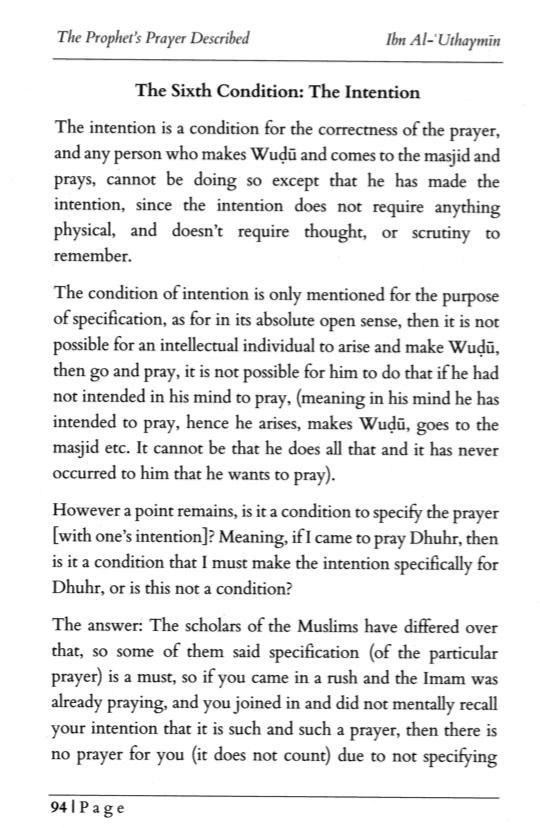
The intention is a condition for the correctness of the prayer, and any person who makes Wudu and comes to the masjid and prays, cannot be doing so except that he has made the intention, since the intention does not require anything physical, and doesn’t require thought, or scrutiny to remember
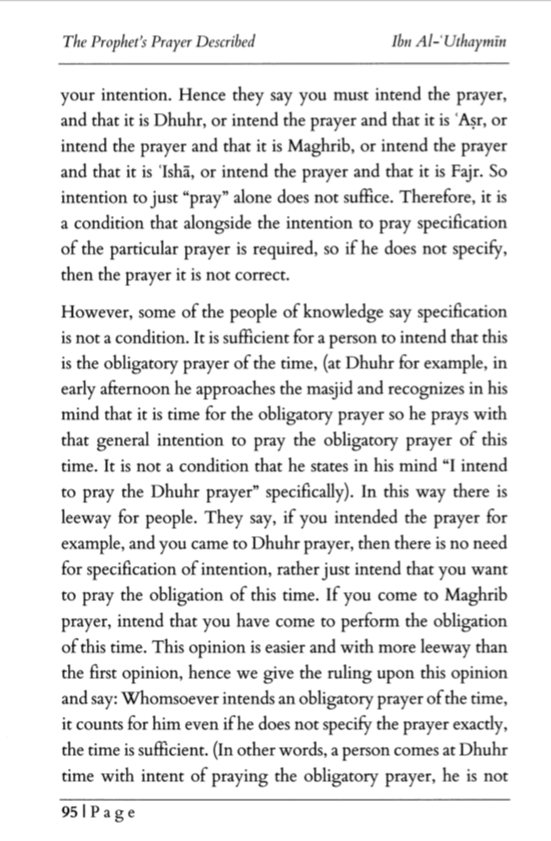
The condition of intention is only mentioned for the purpose of specification, as for in its absolute open sense, then it is not possible for an intellectual individual to arise and make Wudu, then go and pray, it is not possible for him to do that if he has intended to pray, hence he arises, makes Wudu, goes to the masjid etc. It cannot be that he does all that and it has never occurred to him that he wants to pray.



Paraphrased from his Book
 Ahlul-Hadith